
AMH Test Explained: What Is a Good AMH Level for Your Age?
“My AMH is only 1.2. Does that mean I can’t get pregnant?”
“I’m 32, and my AMH is lower than my friend’s. Should I be worried?”
“Is low AMH the same as infertility?”
These are some of the most common questions fertility specialists hear every day.
For many women, receiving an AMH test result can trigger anxiety, confusion, and countless late-night Google searches. A single number suddenly feels like it holds the answer to one of life’s biggest questions:
“Will I be able to have a baby when I’m ready?”
The reality is far more reassuring.
Your AMH level is an important indicator of ovarian reserve, but it does not define your fertility, your chances of pregnancy, or your future as a mother.
In this guide, we’ll explain what the AMH test actually measures, what is considered a good AMH level for your age, and what steps you can take if your results are lower than expected.
What Is an AMH Test?
AMH (Anti-Müllerian Hormone) is a hormone produced by small follicles within the ovaries. Because these follicles contain immature eggs, AMH levels provide valuable information about a woman’s ovarian reserve, or the number of eggs remaining in her ovaries.
One advantage of the AMH test is that it can usually be performed on any day of the menstrual cycle because AMH levels remain relatively stable throughout the month.
Doctors commonly recommend an AMH test for women who:
✔ Are trying to conceive
✔ Have irregular periods
✔ Have PCOS
✔ Are considering IVF
✔ Are planning pregnancy later in life
✔ Are considering egg freezing
✔ Have a family history of early menopause
✔ Want a better understanding of their fertility potential
What Does AMH Actually Measure?
One of the biggest misconceptions about AMH is that it measures fertility directly.
It doesn’t.
The AMH test estimates egg quantity, not egg quality.
This means:
- A woman can have a low AMH level and still conceive naturally.
- A woman can have a normal AMH level but fertility challenges caused by other factors.
- A woman can have a high AMH level and still require fertility treatment.
Fertility depends on several factors working together, including age, egg quality, ovulation, uterine health, fallopian tube function, and sperm health.
Think of AMH as an important piece of the fertility puzzle, not the entire picture.
What Is a Good AMH Level for Your Age?
There is no single “perfect” AMH level.
What’s considered normal depends largely on age because ovarian reserve naturally declines over time.
The table below provides a general guide:
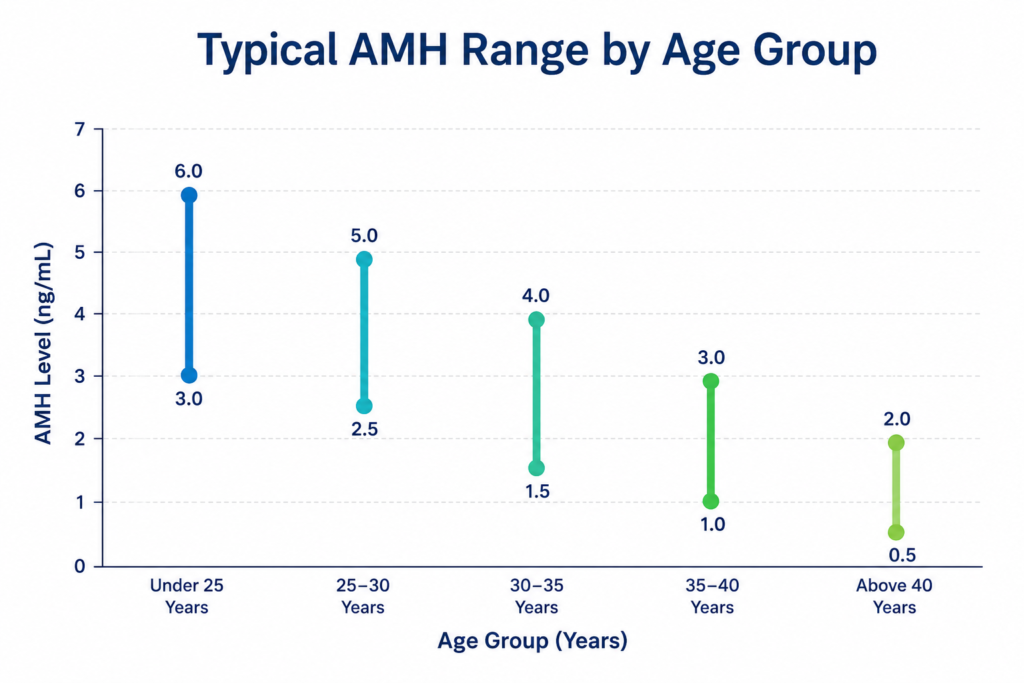
These values are approximate and should always be interpreted alongside your age, ultrasound findings, and overall fertility assessment.
The Biggest Mistake Women Make After Seeing Their AMH Result
Many women receive their AMH report and immediately compare it with numbers they find online.
Unfortunately, fertility does not work like a school exam where a higher score automatically means a better outcome.
Two women with exactly the same AMH level can have completely different fertility journeys.
A 28-year-old woman with an AMH of 1.2 may need further evaluation, while a 38-year-old woman with the same result may still have encouraging fertility prospects.
This is why fertility specialists always evaluate AMH alongside age, ultrasound findings, ovulation, reproductive history, and overall health.
Your AMH number is important, but it is only one chapter of your fertility story.
What Is Considered Low AMH?
Although laboratory reference ranges vary, AMH levels are often interpreted as:
Above 3.0 ng/mL
May indicate a high ovarian reserve and is commonly seen in women with PCOS.
1.0–3.0 ng/mL
Generally considered within the normal range for many reproductive-age women.
0.7–1.0 ng/mL
May suggest borderline ovarian reserve.
Below 0.7 ng/mL
May indicate reduced ovarian reserve.
Below 0.3 ng/mL
May suggest significantly diminished ovarian reserve.
However, low AMH does not automatically mean infertility.
Can You Get Pregnant With Low AMH?
This is perhaps the most important question women ask after receiving their results.
The answer is: Yes, pregnancy is still possible.
Many women with low AMH continue to ovulate regularly and successfully conceive naturally.
Others may benefit from fertility treatments such as ovulation induction, IUI, IVF, or fertility preservation depending on their age and reproductive goals.
The likelihood of pregnancy depends on:
✔ Age
✔ Egg quality
✔ Ovulation
✔ Uterine health
✔ Fallopian tube function
✔ Sperm health
✔ Overall reproductive wellbeing
AMH is only one factor among many.
A Low AMH Result Is Not the End of the Story
One of the most heartbreaking things fertility specialists hear is:
“I thought I had missed my chance.”
Many women see the words low AMH on a laboratory report and immediately assume pregnancy is no longer possible.
But fertility is rarely that simple.
Every year, women with low AMH conceive naturally, while many others successfully achieve pregnancy through fertility treatment.
What matters most is understanding your fertility as a whole not just one hormone level.
A low AMH result should not create panic. Instead, it should encourage informed planning and timely fertility assessment.
Knowledge empowers decisions, and early action often creates more options.
5 Common Myths About AMH Levels
Myth #1: Low AMH Means You Cannot Get Pregnant
False.
Many women with low AMH conceive naturally or through fertility treatment.
Myth #2: High AMH Means Excellent Fertility
Not necessarily.
Women with PCOS often have high AMH levels but may still experience fertility challenges.
Myth #3: AMH Measures Egg Quality
False.
AMH reflects egg quantity, not egg quality.
Myth #4: AMH Can Predict Exactly When Menopause Will Occur
No.
AMH provides information about ovarian reserve but cannot accurately predict menopause.
Myth #5: One AMH Test Tells the Whole Story
False.
A complete fertility assessment includes ultrasound evaluation, ovulation assessment, age, reproductive history, and other fertility factors.
When Should You Consider an AMH Test?
An AMH test may be worth discussing with a fertility specialist if you:
✔ Are over 30 and planning pregnancy later
✔ Have been trying to conceive without success
✔ Have irregular periods
✔ Have PCOS or endometriosis
✔ Have undergone ovarian surgery
✔ Have a family history of early menopause
✔ Are considering egg freezing
✔ Want a better understanding of your fertility potential
Early fertility assessment often provides more reproductive options and greater peace of mind.
Can AMH Levels Be Improved?
Many women ask whether AMH levels can be increased.
In most cases, AMH naturally declines with age and does not significantly increase.
However, maintaining overall reproductive health can support fertility outcomes.
This may include:
✔ Maintaining a healthy weight
✔ Following a balanced diet
✔ Exercising regularly
✔ Avoiding smoking
✔ Managing stress
✔ Seeking early fertility advice
The goal should not be chasing a specific AMH number but optimising overall fertility health.
Fertility Is More Than a Number
In today’s world, fertility conversations often revolve around AMH levels.
While AMH is an important marker, it is not a measure of hope, motherhood, or your future family.
Your fertility depends on many factors working together:
✔ Age
✔ Egg quality
✔ Ovulation
✔ Uterine health
✔ Fallopian tube function
✔ Sperm health
✔ Overall reproductive wellbeing
This is why a comprehensive fertility assessment is always more valuable than interpreting a laboratory result in isolation.
The goal is not simply to understand your AMH level but to understand what it means for you.
Concerned About Your AMH Level?
Whether you’ve recently received a low AMH result, are considering egg freezing, or simply want to understand your fertility potential, getting the right guidance can make all the difference.
Remember:
An AMH number does not define your ability to become a mother.
It is simply information that helps guide fertility planning and treatment decisions.
Dr. Meenu Handa, Director – Fertility & IVF at Motherhood Hospital, Gurugram, offers comprehensive ovarian reserve assessment, fertility evaluation, egg freezing counselling, and personalised fertility treatment plans designed around your unique reproductive goals.
Because your fertility journey deserves clarity, confidence, and expert guidance.
Book Your Fertility Consultation Today.