
IVF Failed Once? Should You Repeat IVF or Get a Second Opinion?
“Your IVF didn’t work.”
Few sentences are as emotionally overwhelming as hearing that your pregnancy test is negative after weeks of medications, injections, scans, egg retrieval, and embryo transfer.
If your IVF failed once, you’re probably asking yourself:
- Should I repeat IVF immediately?
- Did something go wrong during treatment?
- Would another fertility specialist recommend a different approach?
- Do I need more tests before trying again?
The good news is that one failed IVF cycle does not mean IVF has failed.
In fact, many successful pregnancies happen during the second or third IVF attempt after doctors carefully review and personalize the treatment plan.
Let’s understand what your first IVF cycle teaches us and how to make your next step the right one.
Quick Answer
If your IVF failed once, don’t rush into another cycle without understanding why.
The first IVF cycle provides valuable information about:
- Your response to fertility medications
- Egg and embryo quality
- Uterine lining
- Hormonal balance
- Embryo implantation
Sometimes a few modifications are enough to significantly improve the chances of pregnancy. In other situations, getting a second opinion can uncover factors that may have been overlooked.
The goal isn’t simply to repeat IVF; it’s to improve the next IVF cycle.
Did You Know?
IVF success rates vary based on age, embryo quality, and underlying fertility conditions. Many couples achieve pregnancy after more than one IVF attempt because treatment plans can be refined using information gained from previous cycles.
Why Does IVF Fail the First Time?
Many couples believe IVF guarantees pregnancy. The reality is different.
Even under ideal conditions, implantation depends on several biological processes working perfectly together.
One small issue at any stage can affect the outcome.

Common Reasons IVF May Fail
1. Embryo Quality
An embryo may appear healthy under the microscope but still have chromosomal abnormalities that prevent implantation.
These changes are often natural and cannot be predicted simply by appearance.
2. Uterine Receptivity
A healthy embryo also needs a receptive uterus.
Conditions that may reduce implantation include:
- Uterine fibroids
- Endometrial polyps
- Adenomyosis
- Chronic endometritis
- Thin endometrial lining
Even mild uterine problems can affect implantation success.
3. Egg and Sperm Quality
Age remains one of the biggest factors affecting fertility.
Other contributing factors include:
- Low ovarian reserve
- Poor egg quality
- Sperm DNA fragmentation
- Lifestyle factors such as smoking, obesity, stress, or alcohol
Even when semen analysis appears normal, sperm DNA quality can influence embryo development.
4. Hormonal Imbalance
Successful implantation depends on proper hormonal support.
Doctors may review:
- Thyroid function
- Progesterone levels
- Prolactin
- Vitamin deficiencies
- PCOS-related hormone imbalance
Correcting hormonal issues before another IVF cycle may improve outcomes.
5. Sometimes There’s No Clear Explanation
One of the hardest things for couples to hear is:
“Everything looked normal.”
Unfortunately, this happens more often than many people realize.
Modern fertility medicine has advanced tremendously, but not every failed IVF cycle has an identifiable reason.
The important point is this:
An unexplained IVF failure does not mean future IVF cycles won’t work.
IVF Failed Once? It Doesn’t Mean Your Fertility Journey Is Over
This is perhaps the biggest misconception among couples.
A negative pregnancy test after the first IVF cycle is disappointing, but it is not the end of your fertility journey.
Every IVF cycle gives your fertility specialist valuable information, including:
- How your ovaries responded
- Number of eggs retrieved
- Fertilization rates
- Embryo development
- Endometrial response
- Implantation outcome
This information helps create a more personalized treatment strategy for the next cycle.
Many couples conceive after adjustments such as:
- Changing stimulation medications
- Modifying hormone support
- Improving embryo selection
- Adjusting embryo transfer timing
- Treating underlying uterine conditions
Sometimes small changes make a significant difference.
Should You Repeat IVF After One Failed IVF Cycle?
Not always.
Before beginning another IVF cycle, your fertility specialist should review your previous treatment in detail.
Ask yourself:
✔ Was the cause of failure clearly explained?
✔ Will the next IVF cycle be different?
✔ Has your doctor recommended any additional evaluation?
✔ Are you emotionally ready to continue?
If the treatment plan is simply being repeated without understanding what happened during the first cycle, it may be worth asking more questions.
When Should You Consider Getting a Second Opinion?
Seeking a second opinion doesn’t mean you’ve lost trust in your doctor.
It simply means you want to ensure every possible factor has been considered before investing emotionally, physically, and financially in another IVF cycle.
A second opinion may be especially helpful if:
- Your doctor couldn’t explain why IVF failed.
- You’re advised to repeat exactly the same protocol.
- You have PCOS, endometriosis, low AMH, recurrent miscarriage, or male factor infertility.
- You’re over 35 years of age.
- You’ve experienced repeated implantation failure.
- You simply want reassurance before making your next decision.
Many couples feel more confident after another fertility expert independently reviews their reports.
What Happens During a Second Opinion Consultation?
One common concern is:
“Will I have to repeat every test?”
Usually, the answer is no.
An experienced fertility specialist first reviews your existing reports before recommending additional investigations.
The consultation may include evaluation of:
- Previous IVF cycle summary
- Ovarian stimulation protocol
- Hormone reports
- Ultrasound findings
- Embryology reports
- Embryo grading
- Semen analysis
- Uterine assessment
- Previous embryo transfer details
Additional testing is suggested only if it is likely to improve treatment planning.
Repeat IVF vs Second Opinion: Which Is Better?
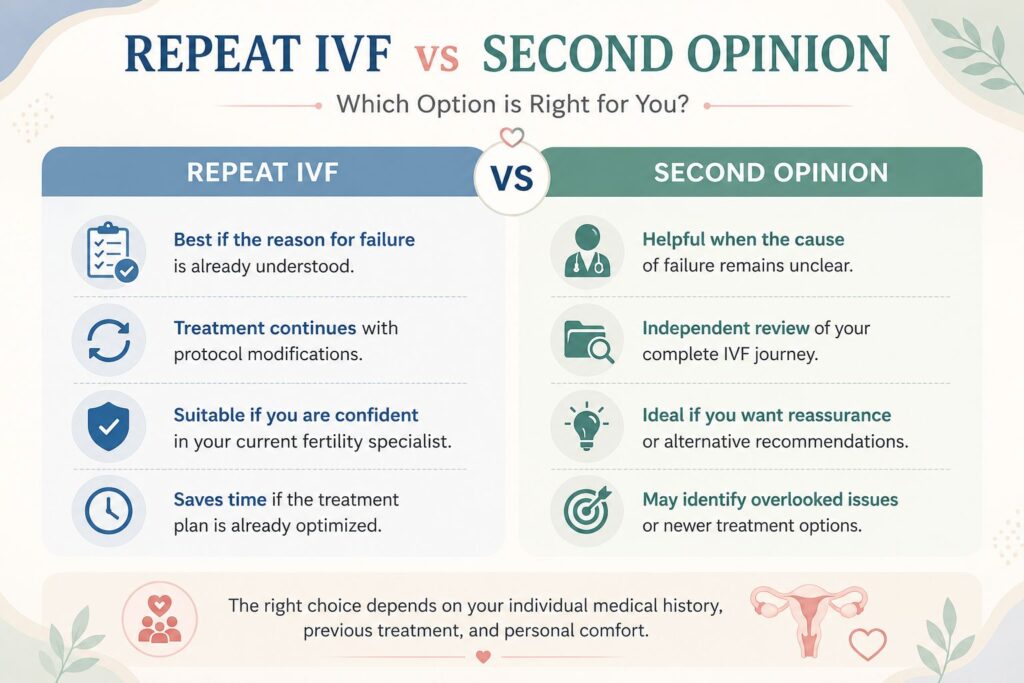
The right choice depends on your individual medical history, not on what worked for someone else.
Expert Insight from Dr. Meenu Handa
One failed IVF cycle should never be viewed as failure; it should be viewed as valuable information. Every treatment teaches us something about how your body responds, allowing us to personalize future care. Rather than repeating the same protocol, our focus is understanding what can be improved so that every next step is more informed and gives you the best possible chance of success.
What Should You Do If Your IVF Failed Once?
If your IVF failed once, remember that this is not the end of your dream of becoming parents.
Instead of rushing into another cycle, take time to understand what happened, discuss your options with your fertility specialist, and don’t hesitate to seek a second opinion if you need more clarity.
Every IVF journey is unique, and every unsuccessful cycle provides valuable insights that can guide a more personalized treatment plan.
At Motherhood Hospital, Gurgaon, every couple receives individualized care tailored to their medical history, prior IVF experience, and future fertility goals. The focus is not simply on repeating treatment but on improving your chances through evidence-based, compassionate fertility care.
Remember: You’re not starting from scratch. You’re moving forward with greater knowledge, a refined treatment strategy, and renewed hope.
Need Guidance After a Failed IVF Cycle?
If your IVF failed once, you don’t have to navigate the next step alone. A detailed review of your previous IVF cycle can help identify opportunities to improve your chances in the future.
Schedule a consultation with Dr. Meenu Handa in Gurgaon to receive a personalized evaluation and discuss whether repeating IVF or seeking a modified treatment approach is the right decision for you.