
Implantation Symptoms Day by Day After Embryo Transfer: What Your Body May Actually Be Telling You
You have completed the embryo transfer. Now comes the part many IVF patients find hardest: waiting.
For the next several days, every cramp can feel significant. A little spotting may make you hopeful, while having no symptoms at all can make you worry that something has gone wrong. If you have been searching for implantation symptoms day by day after embryo transfer, you may have already found plenty of symptom charts, but there is one important problem with most of them.
Your body does not follow a fixed IVF symptom calendar.
Implantation happens at a microscopic level, and many women do not feel it happening. At the same time, progesterone and other medicines used during IVF can cause symptoms that look remarkably similar to early pregnancy.
So rather than telling you that “Day 5 means cramping” or “Day 7 means breast tenderness,” this guide explains what may actually be happening after embryo transfer, what your symptoms could mean, and when a pregnancy test can give you a meaningful answer.
First, when does implantation happen after embryo transfer?
The answer depends on which embryo was transferred.
A Day-5 embryo, or blastocyst, has already reached a more advanced developmental stage when it is transferred into the uterus. It can begin the process of hatching and attaching to the uterine lining relatively soon after transfer.
A Day-3 embryo needs additional development before reaching the blastocyst stage, so its implantation timeline is different.
This distinction is often missed in generic “implantation symptoms day by day” articles.
For a Day-5 blastocyst transfer, implantation may begin within the first few days after transfer and continue over the following days. For a Day-3 embryo transfer, the process generally occurs later because the embryo first needs to develop further.
Implantation itself is not one single event. The embryo needs to attach to the endometrium and gradually embed into the uterine lining. Once implantation is established, the developing pregnancy starts producing human chorionic gonadotropin (hCG), the hormone detected by pregnancy tests.
That is why symptoms and pregnancy-test results do not necessarily appear at the same time.
Implantation symptoms after embryo transfer: a realistic timeline
Instead of looking for a particular symptom on every single day, it is more helpful to understand what is likely to be happening during different stages of the waiting period.
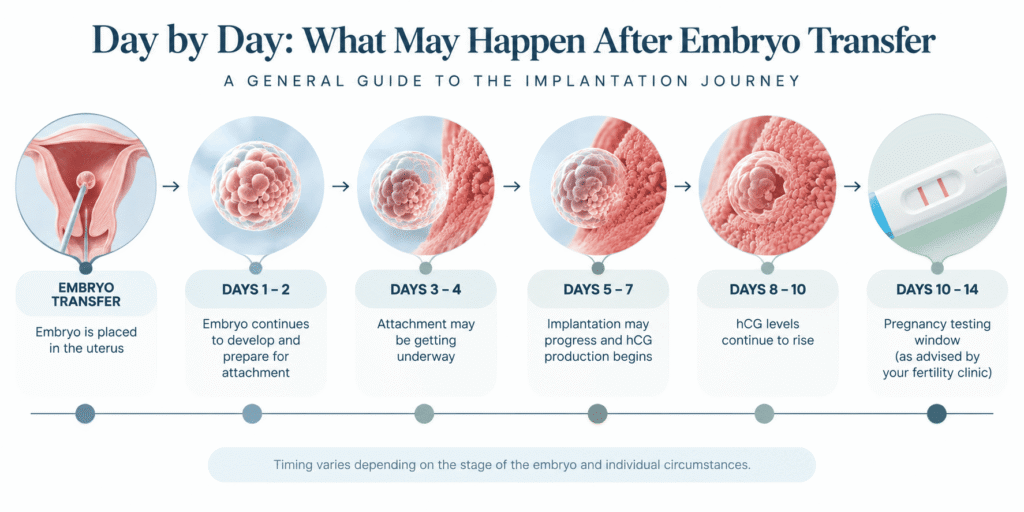
Days 1–2: Don’t expect a pregnancy symptom yet
After a blastocyst transfer, the embryo is continuing its development and beginning the steps that may lead to attachment.
You may notice mild pelvic discomfort, bloating or cramping, particularly after the transfer procedure itself. But these sensations do not tell you whether implantation has occurred.
Progesterone can also make you feel bloated, tired or unusually aware of your breasts.
What if you feel absolutely nothing?
That is normal too.
There is no requirement for implantation to produce a noticeable sensation.
Days 3–4: Attachment may be getting underway
With a Day-5 blastocyst, this can fall within the period when the embryo is attaching more closely to the uterine lining.
Some women report mild, period-like cramps or an occasional pulling or twinging sensation. Others notice no change whatsoever.
This is also where patients can become unnecessarily anxious about symptoms.
A cramp is not a pregnancy test.
It may be related to the uterus, the transfer procedure, progesterone or normal bowel activity. There is simply no way to identify implantation based on one sensation.
Days 5–7: Implantation and early hCG production
If implantation is successful, the embryo becomes increasingly established within the uterine lining, and hCG production begins.
You may notice mild fatigue, breast tenderness, bloating or occasional cramping around this time. A small amount of spotting may also occur.
But here is the part that often gets lost online:
These symptoms can happen whether or not the embryo has implanted.
Progesterone supplementation can cause several of the same symptoms associated with early pregnancy. This is why a woman can have strong symptoms and still receive a negative pregnancy test—or have almost no symptoms and receive a positive one.
Days 8–10: The hormone story becomes more important than the symptom story
If implantation has occurred, hCG is increasing.
This is an important transition because hCG, not cramping, spotting or breast tenderness, is what pregnancy tests are actually looking for.
Some women may begin experiencing early pregnancy symptoms as hormone levels rise. Others may continue feeling completely normal.
This is also why taking a test very early can create confusion. If hCG has only recently started increasing, a urine test may still be negative even when pregnancy is developing.
Days 10–14: Time for meaningful testing
By this stage, many fertility clinics will have scheduled the pregnancy test, depending on the type of embryo transferred and the treatment protocol.
A beta-hCG blood test is commonly used because it can detect and measure hCG more precisely than relying on symptoms.
The exact testing date should always come from your fertility clinic. Testing significantly earlier than advised can result in unnecessary confusion from an early negative result, and in some IVF protocols, medication used earlier in the cycle can also affect testing.
Implantation symptom or IVF medication? Here’s the part patients often miss
One of the most useful ways to understand the symptoms after embryo transfer is to stop asking, “Is this a pregnancy symptom?” and instead ask:
“What else could be causing this?”
| What you notice | What it could be |
| Mild cramps | Uterine changes, transfer procedure, progesterone or possible implantation |
| Breast tenderness | Progesterone or early pregnancy |
| Bloating | Progesterone, ovarian changes or digestion |
| Fatigue | Progesterone, stress, poor sleep or early pregnancy |
| Light spotting | Cervical irritation, vaginal medication or possible implantation |
| No symptoms | Completely normal; symptoms are not required for implantation |
This is why implantation symptoms after embryo transfer cannot be used as a reliable pregnancy test.
The symptom itself matters less than its timing, severity and the overall clinical picture.
Can you actually feel implantation?
This is one of the most searched questions after IVF.
The honest answer is: implantation does not have a specific, identifiable sensation.
Some women describe mild cramps, pressure, or a brief pulling feeling around the time implantation may be occurring. But these sensations are not unique to implantation.
The embryo is microscopic, and the implantation process takes place within the uterine lining. There is no particular physical feeling that can confirm, “My embryo has implanted.”
So if you are sitting at home after embryo transfer and wondering whether that tiny cramp was implantation, there is no reliable way to know from the sensation alone.
What if you have no implantation symptoms after embryo transfer?
This deserves more attention because it causes a lot of unnecessary worry.
You can have a successful embryo transfer and experience:
No cramps.
No spotting.
No breast tenderness.
No nausea.
No unusual fatigue.
And still be pregnant.
Early pregnancy symptoms are influenced by hormone levels, individual sensitivity and medication. They do not appear in exactly the same way for everyone.
In fact, symptoms can sometimes create more confusion than reassurance because progesterone can mimic several early pregnancy symptoms.
So don’t use the absence of symptoms as evidence that your embryo has not implanted.
When should you take a pregnancy test after embryo transfer?
The most important rule is simple:
Test when your fertility clinic tells you to test.
Many clinics schedule pregnancy testing approximately 9–14 days after embryo transfer, although the exact timing varies with the embryo stage and clinic protocol.
If you test too early and get a negative result, it may simply be too soon for hCG to reach a detectable level.
And if you have been prescribed progesterone or other medicines, do not stop them based on symptoms or an early home pregnancy test unless your fertility specialist tells you to do so.
When should you contact your fertility specialist?
Mild cramping or light spotting can occur after embryo transfer. However, certain symptoms should not simply be attributed to implantation.
Contact your fertility clinic if you experience heavy vaginal bleeding, severe or persistent abdominal pain, fever, dizziness, fainting, breathing difficulty or significant worsening of your condition.
Following a positive pregnancy test, significant bleeding or sharp abdominal pain—particularly one-sided pain—also requires medical assessment because an ectopic pregnancy, although uncommon, can occur after IVF.
The two-week wait is not a symptom test
After embryo transfer, it is natural to want reassurance from your body.
But implantation is happening at a microscopic level. Your body may give you clues, or it may give you none. Neither tells the complete story.
The most meaningful sequence is:
Embryo transfer → possible implantation → rising hCG → pregnancy test → ultrasound when appropriate
Not:
Cramp → Google → spotting → Google again → more anxiety.
If you are undergoing IVF, try to follow the medication and testing plan given by your fertility specialist rather than judging the outcome from symptoms alone.
For women undergoing IVF treatment in Gurgaon, understanding what is normal after embryo transfer can make the waiting period a little less confusing. At every stage, however, your individual embryo, treatment protocol and medical history matter more than a generic symptom chart found online.
A final word from your fertility specialist
The days between embryo transfer and the pregnancy test can be filled with questions, but you do not have to decode every sensation.
A little cramping does not automatically mean success. No cramping does not automatically mean failure. Spotting does not give a definite answer, and neither does the absence of spotting.
The pregnancy test, not the symptom checklist, is what ultimately tells us whether implantation has led to pregnancy.
If you have concerns during your IVF journey, speak with your fertility specialist rather than trying to interpret symptoms on your own. Personalised advice is particularly important when symptoms are unusual, persistent or severe.