
IVF Success Rate by Age in 2026: What to Realistically Expect
The IVF success rate by age generally declines as age increases, particularly with own-egg IVF, due to changes in egg quantity and quality. However, age is not the only factor. Ovarian reserve, embryo quality, sperm health, uterine factors, fertility diagnosis, and previous treatment response can also influence IVF outcomes.
If you are researching the IVF success rate according to age, it is important to understand what a reported percentage actually measures. Pregnancy rates, live birth rates, success per embryo transfer, and cumulative success after egg retrieval are not interchangeable.
What Is the IVF Success Rate by Age?
The IVF success rate by age describes the likelihood of achieving pregnancy or a live birth through IVF at different ages. While success rates generally decline with increasing age, particularly with own-egg IVF, the actual outcome depends on several individual factors.
When comparing IVF success rates by age, consider:
- Age: IVF success is generally higher at younger ages and tends to decline, particularly from the mid-to-late 30s.
- Egg quality: Increasing age is associated with a higher chance of chromosomal abnormalities in eggs.
- Success rates can mean different things: Always check whether a figure refers to pregnancy or live birth and whether it is calculated per cycle, retrieval, or embryo transfer.
- Rates are not individual guarantees: Published figures represent groups of patients and may not reflect your personal chances.
- Treatment type matters: Success rates for own-egg IVF and donor-egg IVF should be considered separately.
Why Does Age Affect IVF Success Rates?
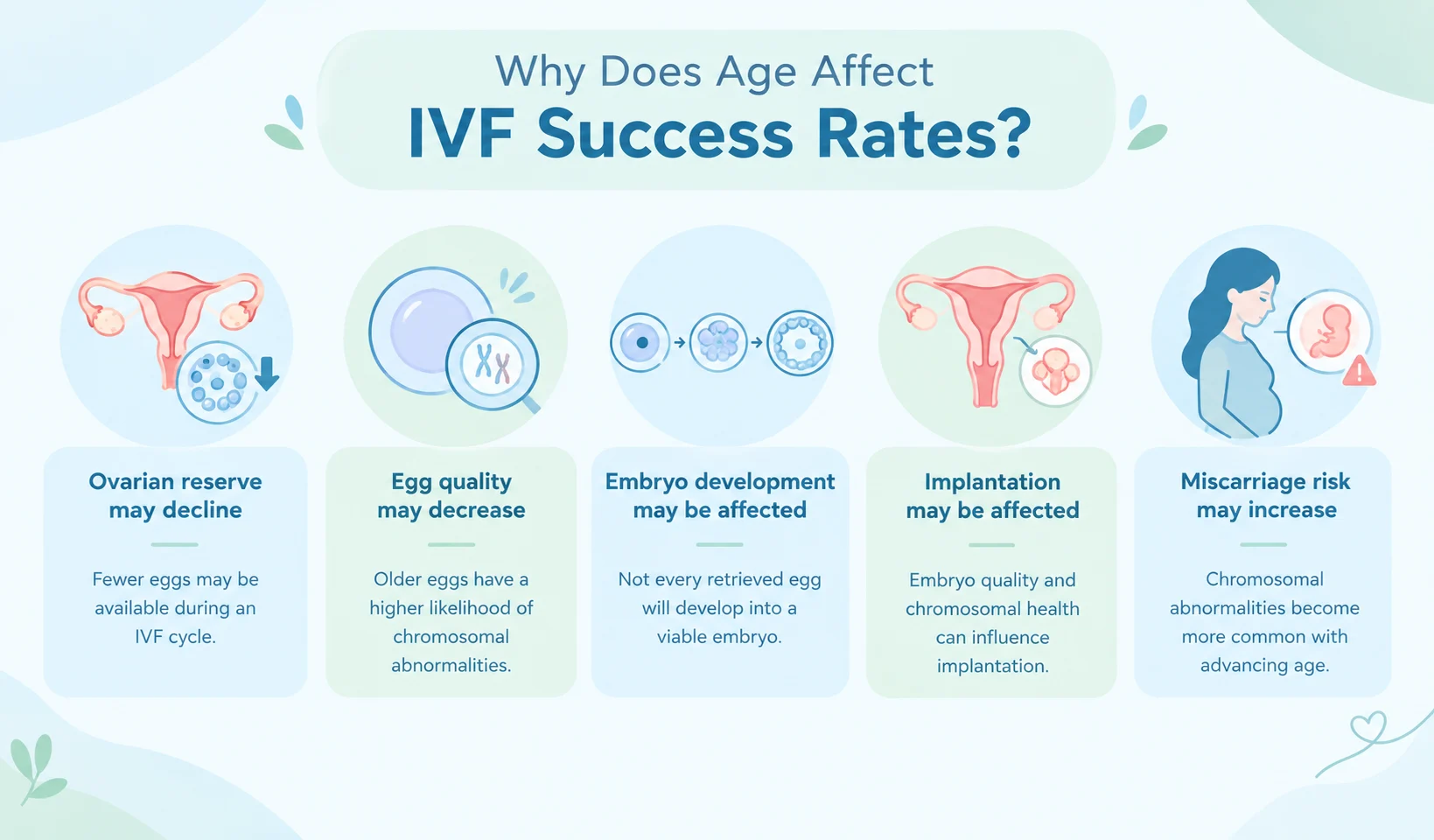
Age affects IVF success mainly because egg quantity and quality change over time. As age increases, ovarian reserve generally declines, and chromosomal abnormalities become more common, which can affect embryo development, implantation, and pregnancy outcomes.
These age-related changes can influence IVF in several ways:
- Ovarian reserve may decline: Fewer eggs may be available during an IVF cycle.
- Egg quality may decrease: Older eggs have a higher likelihood of chromosomal abnormalities.
- Embryo development may be affected: Not every retrieved egg will develop into a viable embryo.
- Implantation may be affected: Embryo quality and chromosomal health can influence implantation.
- Miscarriage risk may increase: Chromosomal abnormalities become more common with advancing age.
This is why the IVF success rate by age with own eggs is generally different across age groups.
How to Interpret IVF Success Rates As Per Your Age
When looking at the IVF success rate by age, consider more than the percentage alone. The meaning of a success rate depends on the patient’s age, treatment type, outcome being measured, and individual fertility factors.
Before comparing IVF success rates, consider:
- Your age group: Rates can vary significantly between age groups.
- The outcome measured: Pregnancy and live birth rates are different.
- How the rate is calculated: Check whether it is per cycle, retrieval, or embryo transfer.
- Own versus donor eggs: These represent different treatment scenarios.
- Your fertility profile: Ovarian reserve, embryo quality, and reproductive history also matter.
- Your previous treatment response: This can provide useful information when planning further IVF.
- Your personalised assessment: A fertility specialist can put age-based statistics into context based on your individual circumstances.
IVF Success Rate by Age Group in 2026
The IVF success rate by age generally declines as women get older, particularly when using their own eggs. Age affects both egg quantity and quality, which can influence fertilisation, embryo development and the likelihood of a successful pregnancy. The following figures are broad estimates for understanding age-related trends, not guaranteed individual outcomes.
IVF involves retrieving eggs, fertilising them with sperm in a laboratory and transferring an embryo into the uterus. Advances such as embryo freezing, genetic testing and more personalised ovarian stimulation have improved how treatment can be planned, but female age remains an important predictor of IVF outcomes.
Approximate IVF success rates by age:
| Age | Approximate IVF success rate |
| Under 30 | IVF success rates are generally higher in women under 30 when using their own eggs, as younger age is associated with better egg quality and reproductive potential. |
| 30–34 | Women aged 30–34 generally have favourable IVF success rates with their own eggs. However, outcomes can vary depending on ovarian reserve, embryo quality, sperm health, and other fertility factors. |
| 35–37 | From age 35, IVF success rates may gradually decline, particularly with own eggs. Egg quality and ovarian reserve become increasingly important factors when planning treatment. |
| 38–40 | IVF success rates are generally lower between ages 38 and 40 when using own eggs. Your fertility profile and previous treatment response can help your specialist assess your individual chances. |
| Above 40 | After 40, IVF success rates with own eggs are generally lower compared with younger age groups, largely because egg quality and quantity tend to decline with age. Your fertility specialist can discuss treatment options based on your individual assessment. |
These are broad estimates, not individual predictions. IVF outcomes can vary based on age, ovarian reserve, embryo quality, sperm health, and treatment history. Generally, success rates are higher with own eggs under 35, may begin to decline at 35–37, and become more noticeably lower at 38–40 and above 40.
It is also important to understand how a success rate is calculated. Pregnancy and live birth rates are different, and reported figures may be based on an IVF cycle, egg retrieval, or embryo transfer.
Your age-based percentage is a starting point, not a prediction of your individual IVF outcome.
How Can Dr. Meenu Handa Help With Your IVF Journey?
Choosing IVF involves more than understanding success rates. Dr. Meenu Handa, an experienced IVF and fertility specialist in Gurgaon, provides personalised treatment planning based on your age, ovarian reserve, reproductive history, fertility diagnosis, and previous treatment response. Her approach focuses on helping patients understand their options and set realistic expectations throughout their IVF journey.
- 20+ years of experience in fertility and reproductive medicine
- 10,000+ fertility consultations provided
- 5,000+ IVF, ICSI, and fertility procedures performed
- Recipient of 7 national and international awards
- Trusted by patients from 12+ countries
- Expertise in IVF, ICSI, IUI, recurrent IVF failure, PCOS, low AMH, and other fertility concerns
Take the Next Step in Your IVF Journey
Understanding the IVF success rate by age can help you set realistic expectations, but age alone does not determine the outcome of treatment. Factors such as ovarian reserve, egg and embryo quality, sperm health, fertility diagnosis, and previous treatment response also play an important role.
If you are considering IVF in Gurgaon, Dr. Meenu Handa can assess your individual fertility profile and recommend a personalised treatment plan based on your needs. Book a consultation to discuss your IVF options and understand what may be appropriate for you.